
Table of Contents
Introduction: Power of breath for mental peace.
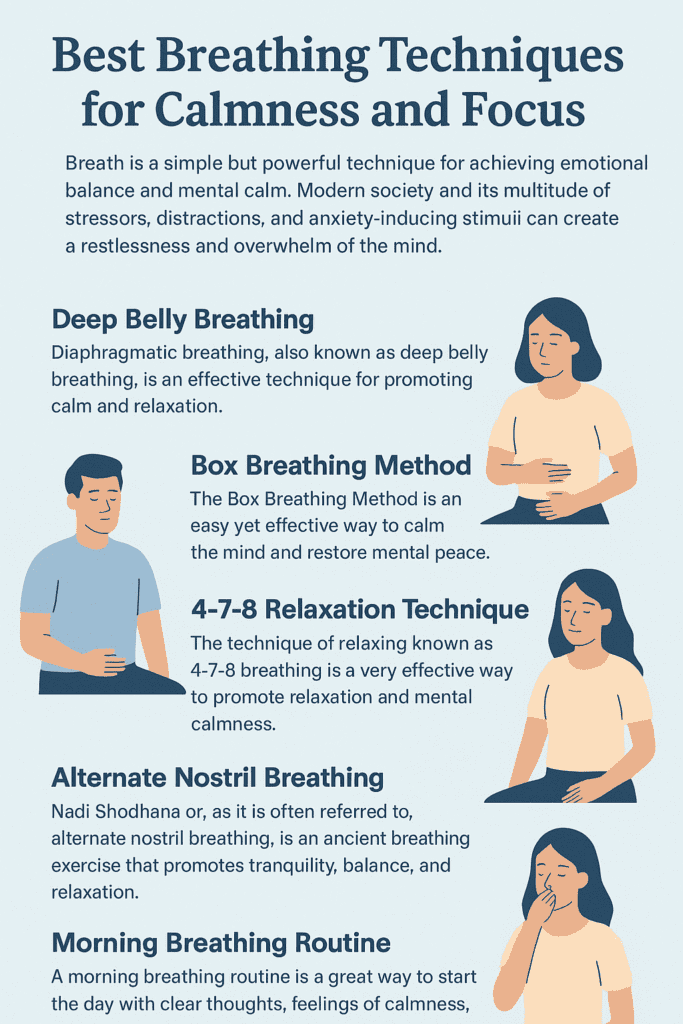
Breath is a simple but powerful technique for achieving emotional balance and mental calm. Modern society and its multitude of stressors, distractions, and anxiety-inducing stimuli can create a restlessness and overwhelm of the mind.
Intentional breath work can be incorporated into a routine to enhance focus, release tension, and soothe the nervous system. By focusing one’s attention on the rhythm, length, and speed of one’s breath, you may quiet racing thoughts, release negativity, and cultivate inner peace.
Breath awareness facilitates mental clarity by connecting the mind and body and helps you feel settled and present in the face of challenges.
Whether applied during meditation sessions, breath work, or mindful breaks throughout the day, breath is a natural and modular way to cultivate clarity of mind and sustain inner peace.
Deep Belly Breathing
Diaphragmatic breathing is also known as deep belly breathing, and is an effective technique for promoting calm and relaxation.
Deep belly breathing draws on the full engagement of the diaphragm, providing oxygen into the lungs while relaxing tension in the body, while shallow chest breathing does not. To practice, sit down comfortably or lie down.
Place one hand on your chest and one on your belly, and then inhale through your nose, allowing yourself to belly breathe.
As you breathe in, feel your belly expand, and as you breathe out gently through your mouth, feel your abdomen contract.
Repeating the process for a handful minutes eases stress hormone levels, quietens your mind, and slows your heart rate.
Including deep belly breathing into your regular routine can help you focus easier, reduce anxiety, and facilitate inner peace.
Box Breathing Method
The Box Breathing Method is an easy yet effective way to calm the mind and restore mental peace. It utilizes equal counts for ending, a breath hold, exhaling, and a pause, typically four counts for each, and is useful for athletes and professionals in highly stressful situations.
To try it, find a comfortable position, inhale slowly through your nose for a count of four and hold this breath fro a count of four. Exhale slowly for four counts and pause for four counts before repeating the process.
You can practice the method for a few minutes for more focus can decrease anxiety and improve the regulation of the nervous system.
Box breathing teaches the mind to follow a controlled rhythm to help induce relaxation, increase emotional regulation, and reassurance with calm, even in stressful situations.
4-7-8 Relaxation Technique
The technique of relaxing known as 4-7-8 breathing is a very effective way to promote relaxation and mental calmness. The 4-7-8 breathing technique is designed to calm the nervous system by including a calming breath strategy of inhaling for 4 seconds, holding for 7 seconds, and exhaling for 8 seconds.
To practice breathing, simply close your eyes, find a comfortable chair or lie down, and let yourself focus on your breath while practicing the 4-7-8 breath. You may complete this cycle for 4-6 iterations.
This will allow your body to find relaxation and will help your stress hormones to lower and your heart rate to slow. After you have practice consistently, 4-7-8 breathing can help increase emotional stability and clarity, as well as enhance the sleep process.
Alternate Nostril Breathing
Nadi Shodhana or, as it is often referred to, alternate nostril breathing, is an ancient breathing exercise that promotes tranquility, balance, and relaxation.
In this practice, you inhale through one nostril while closing the other one with your finger, then gently switch so that you exhale the air from the other side, inhale, and repeat for several rounds.
To begin, find a comfortable seat, preferably a chair or on the floor, with a straight spine. Close off your right nostril with your thumb, take a slow, deep breath in through your left nostril, close it with your ring finger, and then release your thumb from your right nostril to exhale.
Continue this for a few minutes on that side, and then reverse.
You’ll notice that with practice your breathing will lengthen and deepen as this intentional breathing reduces stress, brings balance to your nervous system, and creates increased clarity and focused attention.
Daily practices of alternate nostril breathing can produce a deeper foundation for emotional balance, peace, and a greater feeling of calm and inner peace.
Morning Breathing Routine
A morning breathing routine is a great way to start the day with clear thoughts, feelings of calmness, and energy.
When you begin your day with conscious breathing, you awaken your body, ease stress, and prepare your mind to focus and be productive.
Breathing practices, such as deep belly breathing, 4-7-8 relaxation, or alternate nostril breathing, can easily be used for five to ten minutes after you wake.
When seated comfortably, with a straight spine, and focusing on the rhythm of your breath, you may feel more present and mindful.
This quick practice allows for oxygen flow to begin energizing your body, releasing any tension you may have built overnight.
When your morning breathing practice becomes a daily habit, you are setting a positive intention for the day ahead, staying emotionally balanced, and setting the stage for some mental peace from the very start of your day!
Conclusion: Calm mind starts with mindful breathing.
Mindful breathing is among the most straightforward, yet powerful, skills to help create a calm mind. First, mindful breathing helps establish calmness.
Techniques like deep belly breathing, box breathing, 4-7-8 relaxation, and alternate nostril breathing increase our awareness of breath to ease stress, calm our mind, and relieve tension in the body and mind.
Mindful breathing allows us to be present with the breath so we may face challenges with emotional balance and clarity.
Mindful breathing, which occurs within a few minutes, as a focused practice every day, produces positive brain waves that promote wellbeing, energizes the body, and builds resiliency against potential stress and anxiety.
Practicing mindful breathing in a focused way every day, changes how our mind and body feel toward themselves and the world.
Developing mindfulness with your breath creates calm, improves sleep, and bridges the mind and body connection, reminding us that mindful breathing with consideration and awareness is the first step towards a quiet mind.